 Review: 7Dollar Essay
 Review: Assignment Master UK
 Review: Assignment Tutor UK
 Review: Assignment Ace UK
 Review: 6Dollar Essay
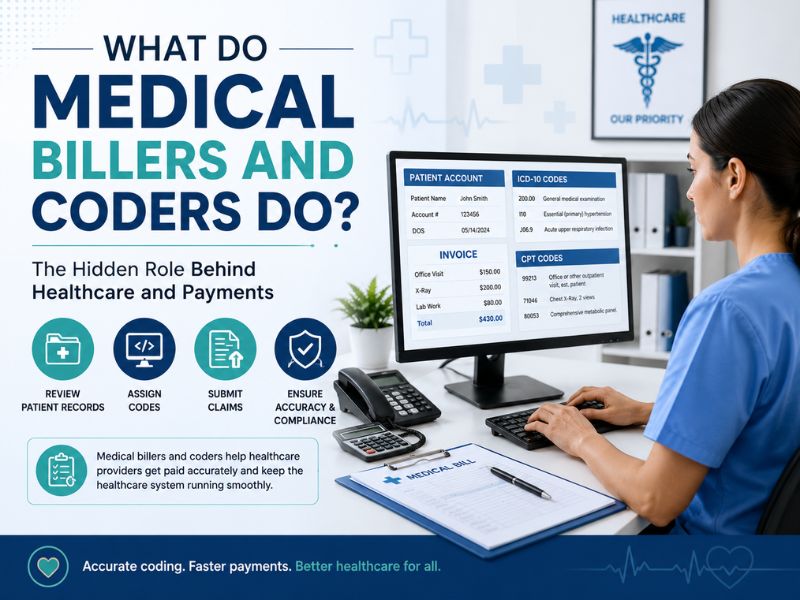
What Do Medical Billers And Coders Do?
Confused about the healthcare revenue cycle process? The coding process includes assigning codes for specific diagnoses and procedures on patient records, while the billing process involves claims processing, communication with the insurance companies, and patient account management.
Bridging Clinical Care And Billing Accuracy
Every time a patient visits a doctor or is hospitalized, there is a series of paperwork that is done to make sure that the healthcare professionals get paid for their important services.
While the patients get to see only the treatment provided to them, there is an untiring team working hard behind the scenes converting these patient visits into monetary transactions.
They are the medical billing and coding professionals who remain behind the curtains of the healthcare industry, serving as the vital link between physicians, insurers, and patients.
Having a clear understanding of their individual importance can explain how the business side of healthcare really operates.
Who Are Medical Billers And Coders
Medical coders and billers are unique administrative experts who coordinate the process of medical reimbursement.
Coding is a process where clinical data such as the doctor’s report, laboratory results, and image studies are analyzed to code diagnoses, procedures, and equipment utilized during a patient’s encounter with a unique alphanumeric code.
Coding, on the other hand, makes use of the same codes in making claims and billing patients for insurance purposes. Whereas coding is all about the “what” of the health care services, billing is all about the “how” of getting the money for the work done.
Translate Clinical Data Into Standard Codes
Accuracy is the foundation of the field of coding. Coders have an extensive understanding of the terms used in medicine, human body parts, and the different coding systems, including ICD-10, CPT, and HCPCS.
Through the translation of medical records into codes, they help create a universal language utilized by the insurance agencies to process claims. The work demands careful attention because even a small mistake can cause denial or legal issues. In cases when health facilities are not able to achieve the high level of accuracy in this process, they usually turn to a medical billing service provider to lift the load, ensuring that all services are recorded accurately and submitted based on the current payer guidelines.
Manage Insurance Claims And Patient Accounts
After coding the medical services, the task now falls upon the medical biller.
Medical billers use the coded information to make formal claims to health insurance companies, government-funded agencies such as Medicare, or even to individual patients.
The task of a medical biller does not stop there since they follow up on the claims and also deal with any problems regarding the claims made to make sure the medical office gets paid. Such a job requires great problem-solving skills as well as being very persistent since dealing with numerous policies of various insurance companies daily determines the financial state of the medical facility.
Enhance Workflow With Advanced Technology
The modern healthcare sector depends heavily on digital technology such as Electronic Health Records (EHR) and billing software.
Using such electronic tools enables billers and coders to organize the data of their patients, automate the claim process, and ensure data security. The advancement of the healthcare industry has enabled many institutions to use AI in helping with the coding process.
AI technology is now able to identify errors or provide possible codes on the basis of the clinical documentation so that human practitioners can concentrate on data validation and handling difficult situations.
Solve Financial Challenges Through Strategic Scaling
As the number of medical procedures increases, the number of claims that arise from them can sometimes be too much for an internal team to manage.
Dealing with administrative functions within a healthcare setting may result in delays due to bottlenecks, overhead expenses, and mistakes.
To ensure efficient operations, many clinics often outsource medical coding services, thus gaining access to a scalable and highly skilled workforce that is always aware of the latest regulations without the necessity of training their own employees.
This collaboration enables healthcare providers to avoid any administrative hassles and helps them concentrate entirely on providing top-notch medical care to patients.
Meet Required Standards Without Disrupting Operations
Billers and coders work within a stringent regulatory environment with HIPAA compliance standards. They keep themselves updated about insurance laws and policies and the continuously evolving federal laws, which are directly related to the processing of claims.
These professionals guarantee that the clinical practice is always audit-ready and in compliance with all financial standards through continued education and certification.
Their vigilance avoids costly fines and helps ensure a good reputation for the company, demonstrating that their contribution is more than just entering data and is actually about risk management and financial sustainability.
FAQs
Is medical billing and coding hard?
It needs a lot of learning because of complicated medical terms, anatomical knowledge, and many changing insurance codes. But once properly trained, it will be quite easy and an interesting career path for those people who like being attentive and solving problems in a medical context.
Is medical billing and coding in demand for 2026?
Yes, it is very much in demand for 2026 and later. There are more jobs in the healthcare field, and it is important to provide compliance in the revenue cycle management. Skilled and certified people are especially valued.
What skills do you need for medical billing?
Among them, there should be attentiveness, knowledge of medical terminology, and good computer literacy. Moreover, efficient billers should be communicative enough to solve any claim problems and be able to manage themselves and handle a large number of accounts.
Is AI taking over medical coders’ jobs?
AI is transforming their jobs but not eliminating them. Even though AI will do automated work and offer suggestions on codes, it will always need human coders to approve complex cases, check their clinical accuracy, and be compliant.
Can I learn medical coding in 3 months?
Yes, there are lots of courses that can teach you medical coding basics within 12-14 weeks. Although the training is pretty fast, it gives you all the basic information about coding to start working professionally.
Final Thoughts
Medical billers and coders play an essential part in constructing the finances of healthcare systems. Their ability to convert clinical activities into standardized information and manage the intricacies of insurance claim submission keeps clinical practices functioning properly and puts patients’ health in focus.
As technology becomes incorporated into their job duties, there is an increased need for people who would be able to control not only automated processes but also human involvement. No matter whether these experts work internally or externally, they bring in the clarity and financial security necessary for ensuring the smooth functioning of modern hospitals, thus demonstrating that accurate documentation is indeed what really makes the difference.